Skip to content
Love for Livres, reading helps us live

Method · Research · Data

Cognitive science and KEI©: measuring the emotions of reading

Books have an emotional signature. We measure it.

Which books should you choose to explore joy, love or surprise? Most books are classified by genre. Most readers, however, are looking for something to feel.

Developed by Love for Livres, the KEI© (Key Emotion Indicator) describes the emotional profile of books to enrich catalogues and open new paths to discovery.

The KEI© (Key Emotion Indicator) is a proprietary method. It qualifies what a book makes you feel. It turns this into data useful to libraries, publishers and readers. It was designed to boost discoverability.

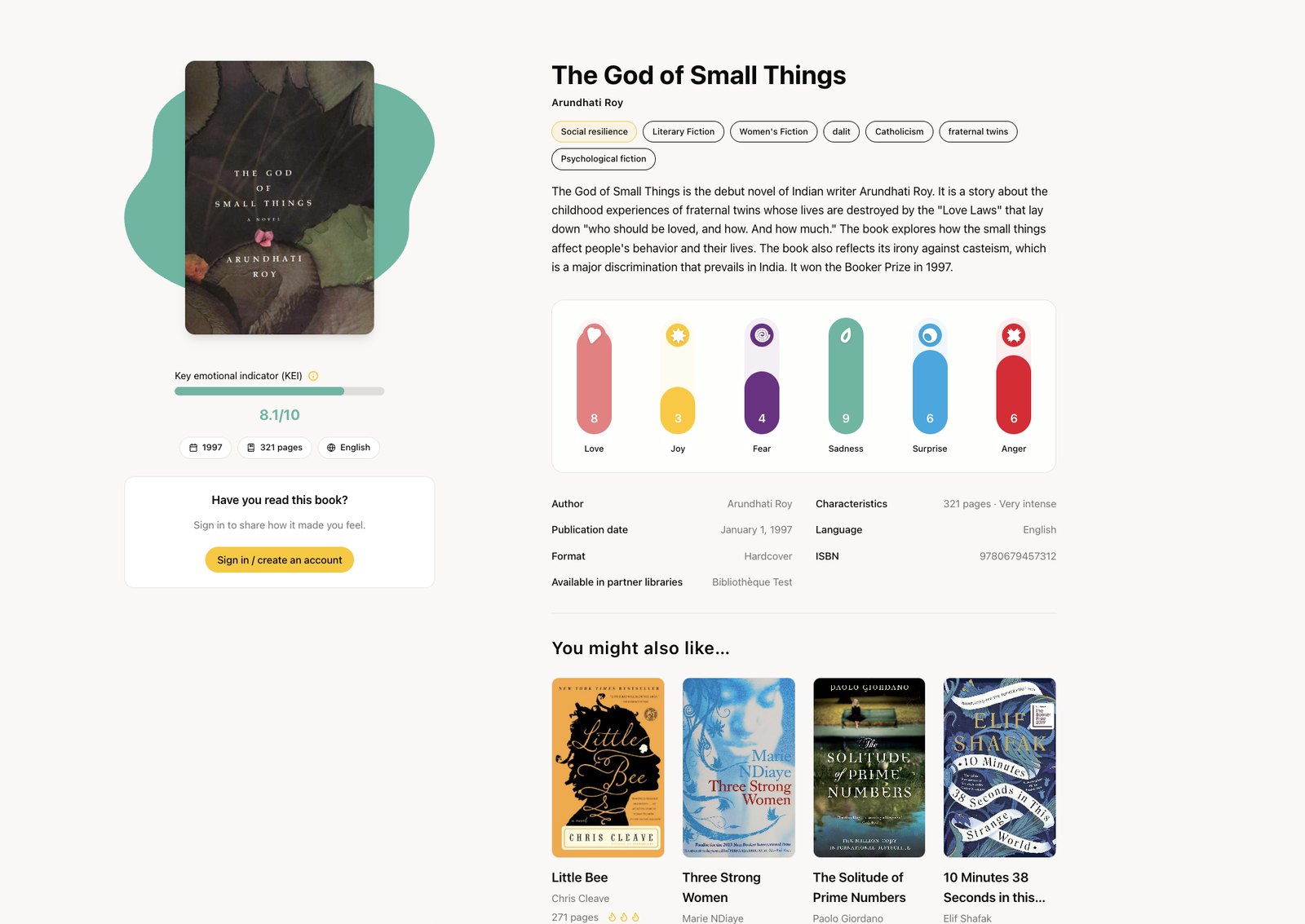
Book page on the Libraries of Emotions platform: The God of Small Things by Arundhati Roy, with its KEI indicator of 8.1 out of 10 and its profile across six emotions (love, joy, fear, sadness, surprise, anger).

Why emotions?

We choose our books with our emotions.

Research in cognitive science has established it well beyond books: emotions play a part in our judgements and decisions. Daniel Kahneman, winner of the Nobel Prize in Economics in 2002, showed the place of intuitive mechanisms in our choices, notably that of the affective impressions that make an option appealing or not. The work of Paul Slovic and colleagues clarifies this mechanism: we also rely on what we feel to assess the possibilities open to us. In 2015, Jennifer Lerner and colleagues synthesised thirty-five years of research showing that emotions influence our decisions powerfully and often predictably, and can either inform or bias them. Kahneman, 2003; Slovic et al., 2007; Lerner et al., 2015.

With books, this influence begins even before reading. In their review of emotions and fiction, Raymond Mar, Keith Oatley, Maja Djikic and Justin Mullin explain that our mood, the emotions we anticipate and our wish to maintain or change our emotional state can steer the choice of a story. Reading can then arouse new emotions, through the characters, the events told and the personal memories they awaken. Emotions thus come into play both in the book we choose and in the experience we have of it. Mar et al., 2011.

This attention to readers' expectations meets a concrete issue: in France, 42% of readers say that a range of books better suited to their wishes and interests could encourage them to read more. This result concerns their expectations in the broad sense, of which emotions can be one dimension. CNL/Ipsos, 2025, p. 55.

Yet existing catalogues almost never say what a book actually makes you feel. Metadata describe a title, an author, a genre, a subject; when an emotion appears, it is the one the book promises, inferred from its cover or its blurb.

Classifying what a book promises is useful. The KEI© adds a way in through emotions, to help everyone discover books beyond the landmarks they already know.

Cognitive science has been at the heart of our practice from the start. Santé publique France, the French public health agency, classifies psychosocial skills into three families, cognitive, emotional and social; reading works on all of them.

Several members of our team, including our co-founder Céline Mas, have trained in the neurocognitive and behavioural approach, and our advisory council includes the neuroscientists Samah Karaki and Ornella Godard.

Sources

Kahneman, American Economic Review, 2003. Slovic P. et al., “The affect heuristic”, European Journal of Operational Research, 177(3), 2007. Lerner et al., “Emotion and Decision Making”, Annual Review of Psychology, 2015. Mar R. A., Oatley K., Djikic M. and Mullin J., “Emotion and narrative fiction: Interactive influences before, during, and after reading”, Cognition and Emotion, 25(5), 2011. CNL/Ipsos, “Les Français et la lecture”, 2025, p. 55 (base: 897 readers, stated intention). Santé publique France, Les compétences psychosociales : un référentiel pour un déploiement auprès des jeunes, 2022.


The KEI©, defined

What is the KEI©?

The KEI© (Key Emotion Indicator) is a proprietary method. It qualifies what a book makes you feel. It provides data useful to libraries, publishers and readers. It was designed to boost discoverability.

It is carried out by human evaluators and by a trained artificial intelligence. For each work, it produces an emotional signature: an overall score out of ten and a score for each emotion.

The result is given at the level of the work; it does not predict what each person will feel. But it shows a tendency.

How it works

Six emotions, an intensity, a profile for each title.

01

A taxonomy

For books aimed at the general public, we work with six emotions: fear, surprise, sadness, joy, love and anger. As love is not an emotion in the strict sense, we gave it the place of disgust in Ekman's classification.

The taxonomy can be configured according to use: an application for children's books, or for another field, may use other emotions.

02

Two routes to evaluation

A trained artificial intelligence corrected by human evaluators (in this case librarians) assesses each work against these emotions. Both routes feed the same index: AI makes it possible to work at scale, human evaluations refine it.

03

A signature

The evaluations are aggregated into an index: an overall score out of ten and a sub-score for each emotion. It is an identifier that is comparable from one title to another and from one language to another.

04

A living index

The index is never fixed. Each new evaluation refines it, without recalculating everything. We do not believe in purely technical models. We believe that human emotions are malleable, and we wanted to create a system that reflects this.

05

A metadata layer

The emotional signature is attached to the work's identifier, its ISBN for a book. Interoperable, it adds to existing metadata without replacing any of it and can accompany the work wherever it is catalogued, recommended or sold.

06

A community dimension

Every reader can complete a questionnaire about their wishes and emotions to receive personalised book recommendations. They can also join a “guild”: a group of readers with similar reading tastes, with whom to talk and share discoveries.

Method, platform, data

A method, a platform and data for your projects

The method

The KEI©, developed and registered by Love for Livres, formulated in 2017 and validated in the field since.

The data

Books linked to what they make real readers feel, in several countries and several languages, exportable and comparable.

The platform

Libraries of Emotions is its reference implementation: a search engine for discovering books by emotion, in 10 languages (German, English, Arabic, Spanish, French, Lithuanian, Dutch, Polish, Slovenian, Ukrainian), deployed with libraries in France, Belgium, Poland, Lithuania, Slovenia, Ukraine and Tunisia, as part of the European LOE for Good project.

The Libraries of Emotions search engine will be launched on 9 October 2026 at the Frankfurt Book Fair, live on the Innovation Stage. See the session ↗

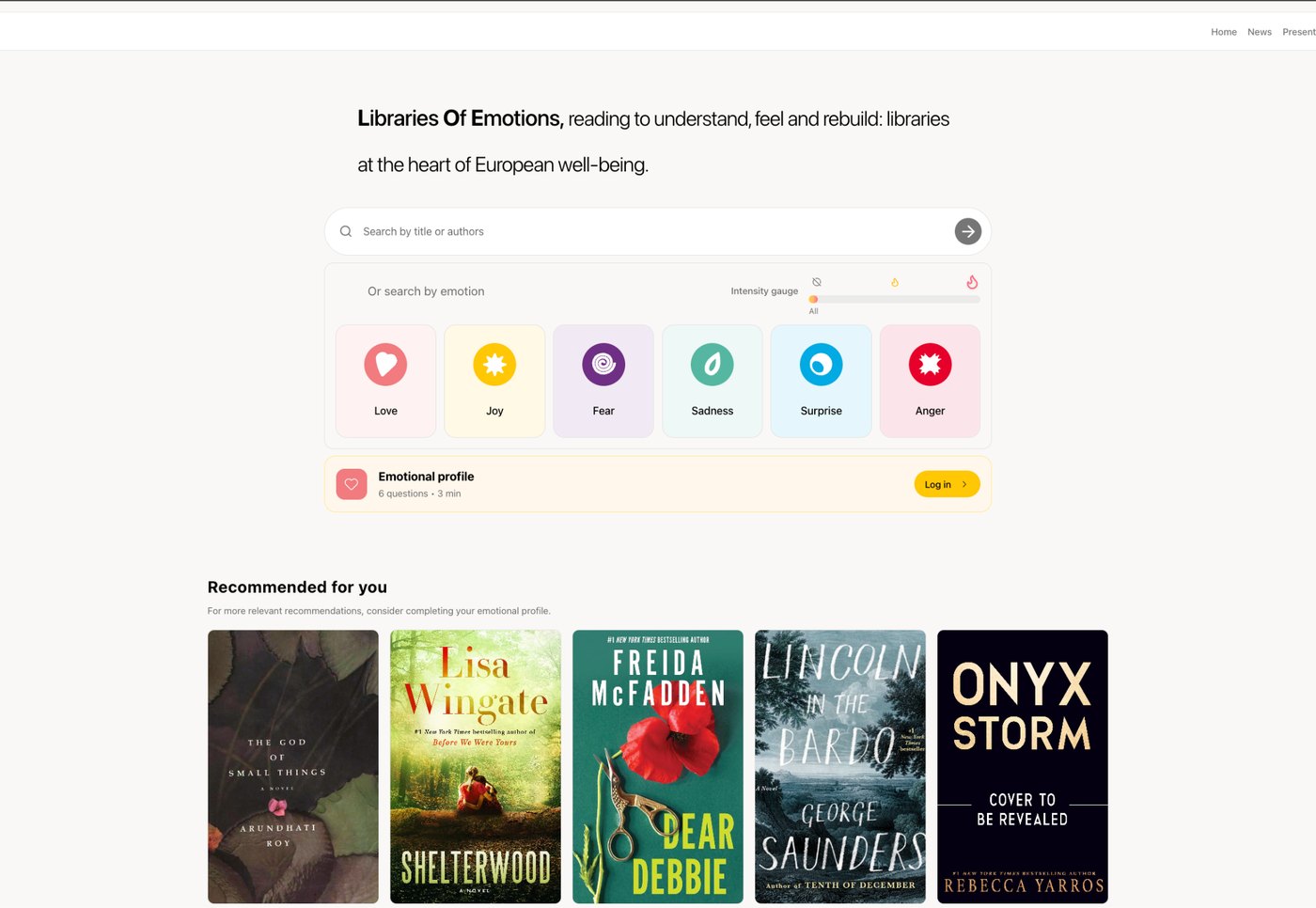
Home page of the Libraries of Emotions platform: search by title or by emotion (love, joy, fear, sadness, surprise, anger) and recommended books.

What it changes

For those who publish, lend, sell or train.

Publishers

Make your backlist work as hard as your new titles.

An enriched catalogue, each title with its emotional profile and a short rationale, ready to enter your metadata chain;a map of the emotions in your backlist, its strong areas and its blind spots;a publishable emotional plurality indicator, which concerns works and not people;ready-to-use selections for a website, a newsletter or a shelf.

Let's talk about your catalogue →

Libraries and bookshops

Build selections and reading spaces by emotion, from the books' profiles. Guide readers other than by genre.

We cover both ends: digital emotional signatures and physical libraries, composed book by book.

Thematic libraries →

Organisations

The same method applies to teams: assessing the emotional effect of a training course or a transformation.

Our tool is interoperable and adapts technically to any technology environment.

Management training →

Results on the ground

A method tested in Europe, research that continues.

96 %

expressed positive emotional responses

95 %

found the sessions met or exceeded their expectations

87 %

wanted to come back

Among more than 160 participants, two European projects, Libraries of Emotions and Bookpower. Mas C., European Journal for Biblio/Poetry Therapy, 2026.

Un coin des émotions dans une bibliothèque partenaire, avec ses cases colorées par émotion

The KEI© has been tested in real conditions for six years, with European libraries and readers. It was validated during two Creative Europe programmes, and our scientific committee gave a favourable opinion on its use in impact assessment. In 2026, the European Journal for Biblio/Poetry Therapy published Céline Mas's analysis of two European projects, Libraries of Emotions and Bookpower, which used the KEI© to classify books by emotion and set up “emotions corners” in public libraries in seven countries. Among more than 160 participants, 96% expressed positive emotional responses, 95% found the sessions met or exceeded their expectations, and 87% wanted to come back. We are also conducting a research partnership with Ghent University on the measurable effects of bibliotherapy.

The KEI© is also recognised at European level: the Libraries of Emotions project is cited among the examples of good practice in the European report “Strengthening Europe through public libraries” (2026), written by an expert group mandated by the Council of the European Union.

This need is now recognised. In March 2026, a European Commission study made discoverability the next frontier for the cultural sector: on the major platforms, European titles typically account for less than 10% of bestsellers, and metadata are identified as a structural barrier.

This institutional recognition encourages us to pursue our approach and our research into these innovative methods, which create value for the book chain as much as for readers.

Sources

European Union, Open Method of Coordination expert group, “Strengthening Europe through public libraries”, annex 3, Best-practice examples, 2026, pp. 41 and 55. European Commission, DG EAC, “Study on the discoverability of diverse European cultural content in the digital environment”, March 2026. Mas C., “Pioneering Emotional Well-being through Books: European Case Studies”, European Journal for Biblio/Poetry Therapy, 2(1), 53-58, 2026, doi:10.65018/EJBPT-vol2iss1pp53-58.

Beyond books.

Books are our reference application, not our limit. The KEI© applies to anything whose value lies in the emotion it arouses: a film, a piece of music, an experience. Applying the method to a new field means defining the right taxonomy for it, not reinventing the method.
We are specialists in emotional impact assessment and we welcome partners who want to apply the method to other activities.

Frequently asked questions

What does KEI© stand for?

Key Emotion Indicator. It is a method registered by Love for Livres to describe what a work makes you feel.

Is the KEI© a certification?

No. It is an impact-assessment method applied to emotions. It certifies neither a work nor a person.

Does the KEI© measure readers' emotions?

It describes the work, based on evaluations by librarians, booksellers, many readers and an artificial intelligence. It says nothing about any particular person. The KEI© presents a profile at the level of the book, from human evaluations and a specialised AI. It does not predict each reader's reaction.

How many books is the KEI© applied to?

Several thousand books, from French and English-language publishers, and the database grows with each new evaluation. Our ambition: to cover at least one million books. Artificial intelligence allows us to extend the database quickly to new catalogues.

Does it replace classification by genre or theme?

No, it adds to it. It is a complementary way in, which integrates with your systems without replacing any of them.

Let's talk about your catalogue, your readers or your teams.

Catalogue diagnostic, selections by emotion, licensing of the method or the platform: we always start with a conversation and then, if it makes sense, with a pilot.